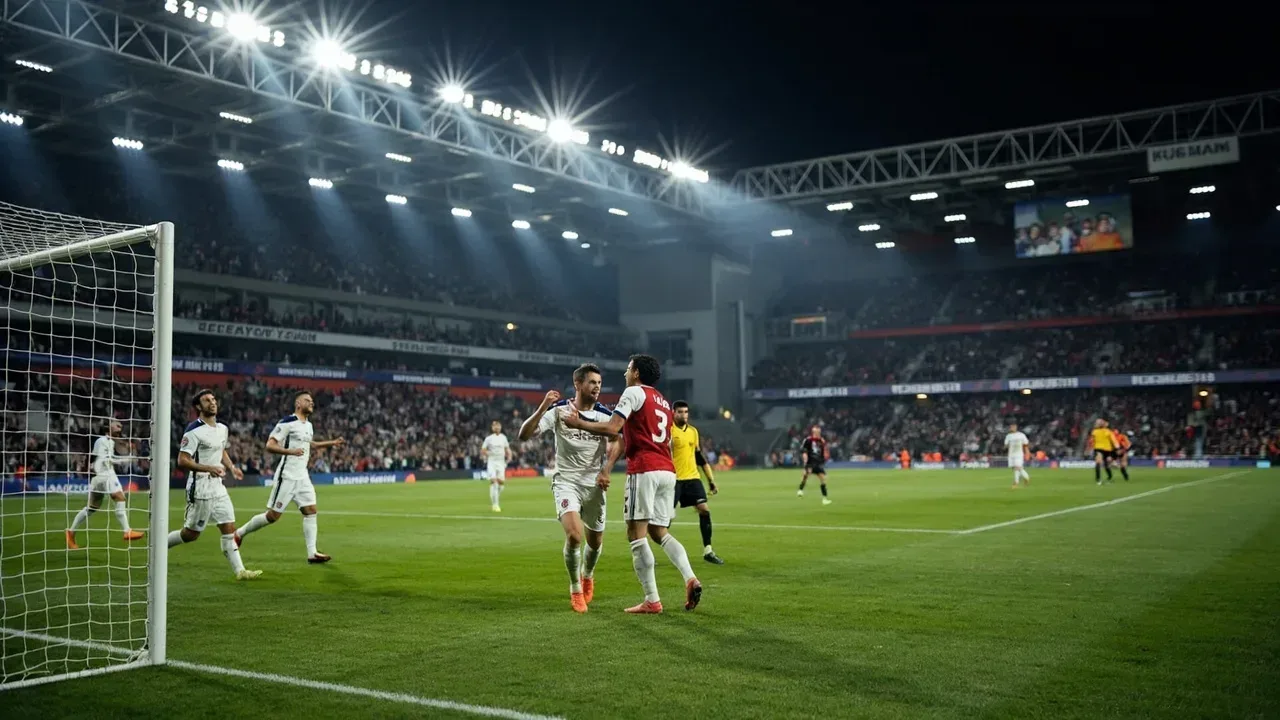
Tactical pattern, Spurs v Brighton, October 2026
De Zerbi at Spurs: the third man run finally arrives
I wrote three weeks ago that De Zerbi’s third man run was a ‘when, not if’ for this Spurs side. The ‘when’ landed on 4 October at the Tottenham Hotspur Stadium, in a 3-1 win over his former club Brighton, and it landed twice. The pattern is no longer a training-ground flourish. It is the most repeatable route to goal in this team, and any coach watching the October footage should be writing it into their own sessions this week.

What the third man run actually is
A third man run, in De Zerbi’s vocabulary, is a combination that uses a wall pass between two players to release a third. It is not a one-two. A one-two is A passes to B, B lays it back, A runs. A third man is A passes to B, B lays it off to C without playing it back to A, and C then runs beyond both. The defender tracking A loses sight of C because the ball has travelled through B in a different direction. The ‘third man’ is C, and the move is older than Ralf Rangnick, older than Arrigo Sacchi, but De Zerbi has made it his signature at Marseille, Brighton, and now in north London. I covered the BBC Sport analysis of his Brighton build-up play in 2023 and the principle has not changed, only the personnel.
Why it works in October 2026 is the question. Spurs’ front four of Solanke, Kudus, Tel and Simons naturally occupy two layers: a near layer (Kudus and Simons) and a far layer (Solanke and Tel). When Simons receives between the lines, he almost always has a forward showing for a wall pass and a wide man showing for a third man option. The pattern needs a defender to step and a defender to ball-watch. Most Premier League back fours are doing one of the two correctly; De Zerbi is exploiting whichever they are not.
The practical point for a coach watching the footage is that the pattern is not built on individual brilliance. It is built on a learned relationship between three players who understand their roles in the combination. Simons is the linker, almost always playing the second pass. One forward acts as the wall, the other runs. The decision about who is who is made in real time, based on the defender’s starting position. That is why the move is repeatable. It does not require a set routine or a fixed trigger; it requires three players who can read the same picture at the same moment, and that is a coaching problem as much as a technical one.
The two goals at the Tottenham Hotspur Stadium
Goal one, 17 minutes. Simons receives from Porro, lays a one-touch pass into Kudus who has dropped short, Kudus without looking slips it first time into the channel. Solanke is already moving. Van Hecke, the Brighton centre back, has tracked the wall pass and is a yard behind the play. The finish is calm. That was the warm-up.
Goal three, 71 minutes, and the cleanest of the night. Bissouma wins the second ball in midfield, plays to Tel who is facing his own goal. Tel backheels to Simons. Simons opens his body and plays a reverse pass into the path of Solanke, who has run off the shoulder of Dunk. Three touches, two combinations, and a defender dead on his feet. Brighton’s right back, Lamptey, is ball-watching Tel and does not see the run. The away end had a quiet minute after that. The full match report is on BBC Sport and it understates the pattern by calling it ‘good combination play’. It is more than that. It is a repeatable scheme.
What I want coaches to take from the two goals is the timing of the second defender’s step. In goal one, Van Hecke stepped to the wall pass. In goal three, Lamptey stepped to the ball at Tel’s feet. Both times, the runner in behind was the player the stepping defender had been responsible for. This is a coaching cue, not a coincidence. The defensive trigger that opens the space is the defensive trigger that loses the runner, and that is a relationship Spurs are training every week on the training ground. Hurzeler’s defenders were caught between two instructions, and that is the gap the pattern lives in.
Why Brighton could not stop it
Hurzeler set up in his usual 4-2-3-1, with Hinshelwood and Rutter as the tens and a high line. Two structural problems became obvious by the 20-minute mark. First, Brighton’s double pivot was dropping too deep when Simons received between the lines, which gave Spurs a free third man option in the pocket. Second, the full backs were stepping aggressively to the wall pass because Brighton press high, but the centre backs were not adjusting their line to cover. You cannot press the first combination and hold the back four. Hurzeler tried to fix it at half time, moving Mitoma to right back and Lamptey to right wing, but the pattern was already in the players’ heads.
Spurs recognised it. De Zerbi’s halftime instruction, which he repeated in the post-match interview with BBC Sport, was to keep finding Simons between the lines. ‘The space is always there, the team has only to keep looking,’ he said. He is a coach who has always trusted patterns over individual brilliance, and that trust is now showing on the touchline.
There is a wider coaching lesson here for anyone facing a team that uses the third man run as a primary weapon. The defensive answer is not a single instruction but a coordinated one. The centre back must read the wall pass and hold his line, the full back must read the runner and step late, and the midfield pair must screen the pocket rather than drop into it. Brighton failed on at least two of those three jobs in the same phase of play, and that is the standard required to stop a side who have made the third man a habit. The UEFA technical report on combination play makes the same point in its section on defensive coordination against third-man combinations, and the Brighton goals are a useful live example of what happens when that coordination breaks down.
What it means for Spurs’ next six
The run-in to the November international break includes Aston Villa away, Manchester City at home, and a trip to Frankfurt. Each of those opponents will set up differently. Villa’s low block will sit off the third man run because the space behind is the space they want to protect. Manchester City’s man-marking scheme will track runners, which kills the pattern. Eintracht Frankfurt will press the first combination, which is the cue to invert it.
The lesson from October is that De Zerbi has at least three versions of the same idea. If the centre back steps, run in behind. If the full back steps, run into the half space. If neither steps, Simons turns and plays forward. It is the same pattern with three outcomes. I will be writing more on the inverted version in my coaching notes this week, with session plans for the under-15 group I take on a Saturday morning.
There is also a personnel point. Solanke’s timing of the run off the shoulder is what makes the pattern finishable, and his absence through the small knock he picked up in the second half would change the threat profile immediately. Tel, as the wall pass option in the third goal, is a different sort of player to Richarlison, who tends to want the ball to feet. If De Zerbi has to rotate, the pattern still works but the runner in behind becomes a different sort of runner, and that is a variable worth tracking through the next four league fixtures before the international break.
The coaching cue for your own sessions
If you are working with a front four at any level, set up this practice. Two attackers start level with the last defender. One midfielder receives between the lines. The two attackers must decide: which one is the wall pass option and which one is the third man. The defenders must decide: who steps to the ball and who tracks the runner. Play three touch, finish in the box. The constraint I add is that the midfielder cannot pass forward first time; he must play through another player. That forces the third man thinking. After eight minutes, switch the roles. The detail that matters is the second defender’s starting position. If he is level with the first defender, the run always beats him. If he is five yards behind, the run is offside. The middle position, three or four yards behind, is where the third man comes alive. That is the picture Spurs are painting right now.
A second constraint worth adding, once the first pattern is repeatable, is a time limit. The midfielder has two seconds to release after receiving. That stops players ball-watching and forces a clean combination. A third layer, for older groups, is to allow the wide player to invert and become the third man from deep, which is the inverted version Spurs used against Frankfurt in pre-season and which I will break down in a separate post. The principle is the same in every version: two players combine, a third runs, and the defenders have to solve a problem they were not set to solve. That is the whole job, and that is what De Zerbi is coaching every day at Hotspur Way.