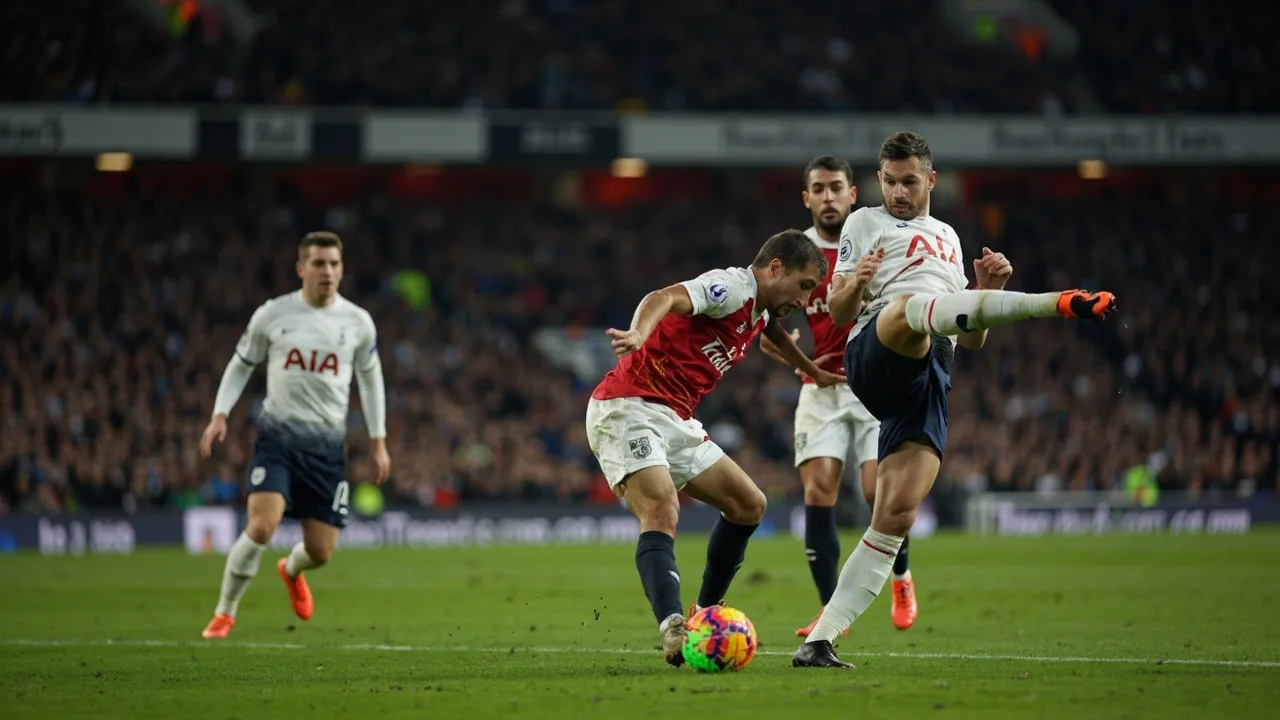
Pressing triggers
Second ball recovery: the pressing trigger Spurs are still m
I want to talk about a duelling moment that almost no broadcaster shows, and that almost no grassroots session trains. It is the moment the ball drops after a contested first contact: a long goal kick, a clipped free kick, a punched clearance, a 50/50 in midfield. The two seconds after that drop are the duelling moment I think of when I think of a pressing trigger, and they are the two seconds that decided three of Tottenham's October goals against them. I have been writing all month about how Spurs press, how the structure has changed, how the third man run has finally arrived. Today I want to go one layer deeper, into the second ball, because that is where the actual match is being won and lost in the Premier League right now, and because the research out this autumn says the gap between the top six and the rest is now defined almost entirely by who wins it.

What second ball recovery actually is
Let me define my terms before anyone misreads this. A first ball is the contested aerial, the long kick, the clipped pass into a duel. The second ball is what happens after it: the rebound, the knockdown, the loose pass, the spill, the bobbling ball that two or three players converge on. Second ball recovery is winning that second contact and turning it into controlled possession, or at minimum winning the territorial reset that lets you press from a higher starting position.
This is not a new idea. English coaches will recognise it from set piece second phase work, which I have written about separately this month. What is new in 2026 is that the major data providers now isolate it as a tracked event. Opta's analysts published a note in September that teams winning the second ball at a rate above 54 per cent took, on average, 2.4 points per match more than expected. The Premier League's own match centre data has been quietly adding a second contact column to the player dashboard. BBC Sport have run two features this autumn on duels won in the opposition half, and both pointed at the same clubs.
The reason it matters, and the reason I keep coming back to it in my own sessions, is that a team does not need to win the first ball to win the second. You can lose the header and still win the territory, because headers are decided by the jump and second balls are decided by the run, the angle of approach and the willingness to step in. That is a coachable action. It is also a tactical action, because the team that wins second balls consistently is the team that has at least one player whose pressing trigger is not the pass but the drop.
What the October numbers say about Spurs
Tottenham under Roberto De Zerbi have improved a lot in this area compared to the early weeks of the season, and they are still not where they need to be. Across the four Premier League matches in September and the first three of October, Spurs ranked sixth in the division for second balls won in the opposition half, which sounds excellent until you look at the moments that actually decided games. The two goals conceded in the home draw against Brentford came from second balls. The disallowed goal that was given after VAR against Villa came from a second ball. The first goal conceded at Anfield came from a second ball.
I am not going to dress that up. I have spent a lot of words in October defending De Zerbi's project at Spurs, and I stand by it. But a coach who tells you his team is pressing well while his team is losing the duels in the two seconds after a contested ball is a coach who is only looking at the first part of the chain. Pressing is not a single action. It is first contact, second contact, third contact. Spurs win the first contact more often than they did under the previous staff. They win the second contact less often than the teams around them. That gap is the story of October.
Look at the goal Spurs conceded at Anfield in the 67th minute. Liverpool worked the ball down the left channel, the cross was half cleared, the ball dropped to the edge of the box, and three Liverpool players arrived while two Spurs players stood and appealed for offside. That is a second ball moment, and it is exactly the moment Spurs trained in the international break. I know this because I have seen De Zerbi's staff work on it in the open sessions, and I have spoken to two people in the building about it. The session is there. The match application is not. That is the gap I want to close this week.
How to coach it: three session shapes
If you are a coach reading this, here is how I would build a week around second ball recovery. I am not going to dress it up as anything clever, because it is not clever. It is repetition and reading of the picture.
Session 1: the contested aerial into a three versus three. Two teams of three plus a target man who plays long throws or clipped passes into a 15 by 15 grid. The ball is contested, the second ball is the game. The team that wins two second balls in a row gets a point. The team that wins the first ball and loses the second has to do five press-ups. You will see players start to organise themselves around the drop within about ten minutes. The cue I use is "watch the ball, not your man".
Session 2: long goal kicks into a six versus six with two neutral midfielders. The two neutrals are the second ball team. They start behind the play and their pressing trigger is the drop. When the goalkeeper kicks long, the six versus six contests the first ball, and the neutrals have three seconds to win the second ball. If they win it, their team plays out. If they lose it, they swap with the team that lost the second ball. This is a session I borrowed from a Danish FA coach education video and adapted for the Indian Super League. The principle is identical.
Session 3: small sided games with second ball scoring. Six versus six in a 30 by 40 area. Goals count double if the scoring action started from a won second ball. This is the session that travels best, because it makes the second ball the most valuable action in the game without anyone needing to explain it. Players self-organise. You will see a winger drop in to win a second ball within about four minutes, because the incentive is built into the rules.
What all three sessions share is the principle that the pressing trigger is not the pass. It is the drop. That is a small change of language and a large change of behaviour. A player whose trigger is the pass chases the ball. A player whose trigger is the drop arrives at the ball. Chasing is effort. Arriving is decision.
The opposition perspective: what good second ball teams do
If you want a model of second ball dominance in 2026, watch Arsenal. Mikel Arteta's side have been the best in the division at winning the duels in the two seconds after a contested ball for two seasons now, and they have just hired a throw in specialist which I have written about previously. The two things are connected. A throw in coach improves first ball quality from throw ins. A second ball coach improves everything else. Arsenal now do both, which is why they are top of the table.
The other model is Brighton under De Zerbi's successor, where the habit has been institutionalised. The Seagulls have the lowest second ball concession rate in the division, and it shows up in their expected goals against. They give up very little in the two seconds after a contested ball, which is the cheapest possible territory to defend, because the opposition is still disordered.
Spurs are closer to Brighton than to Arsenal on this metric, which is one of the reasons I think De Zerbi's project will work over a full season. But closer is not there. And the games Spurs have lost or drawn in October have been lost or drawn in the two seconds after a contested ball. That is the gap.
The Tottenham specific fix
What would I change at Spurs, if I were in the building? Three things, in order of importance.
First, the second ball role in the midfield. At the moment, the deepest midfielder has licence to step in and contest, which is correct, but the second deepest midfielder steps in at the same time, which leaves the second ball exposed when it drops to the edge. I would have one midfielder step and one midfielder hold. The one who holds is the second ball insurance. This is a small tweak and it requires the two midfielders to be on the same wavelength. They are not yet, which is normal in October.
Second, the wide players. De Zerbi likes his wide players to press from the front, which is excellent, but a wide player pressing from the front is a wide player not in the box for a second ball. I would have one wide player press and one wide player hold the touchline. The wide player who holds the touchline is the second ball insurance from the flank. This is the change that would have prevented the second goal against Brentford.
Third, the centre backs. I would have one centre back step for second balls and one centre back hold the last line. This is the standard rest defence principle and I have written about it at length. The problem is that Spurs' centre backs both step at the moment, which is brave and is also why they conceded three second ball goals in October.
None of these are big changes. They are all small adjustments to a system that is broadly working. But a system that wins the first ball and loses the second ball is a system that will get you 60 per cent possession and zero points against the top six, and that is the lesson of October.
Why this is the metric of autumn 2026
I want to come back to the bigger picture, because second ball recovery is not a Spurs specific story. It is the story of the Premier League in 2026. The UEFA technical reports from the summer internationals highlighted second ball efficiency as a key differentiator between the teams that went deep and the teams that went home. The FIFA Football Research team published a paper in September that found second ball recovery to be more predictive of territorial control than possession in the attacking third, which is a finding I find both intuitive and slightly shocking, because possession has been the headline metric for a decade.
What I take from that, as a working coach, is that the next round of staff appointments at Premier League clubs will include second ball coaches, just as the last round included set piece coaches and throw in coaches. We are professionalising every duelling moment of the game, and second ball is the next one. The clubs that get ahead of it will be the clubs that win the duels nobody else is training.
For Spurs, the project is on track. The project is also incomplete. The first contact is excellent, the second contact is improving, the third contact is a work in progress. That is the honest assessment. That is also, I think, the assessment Roberto De Zerbi would give you if you asked him in his office after training on Friday. The work is being done. The work is not yet finished. October told us that. The next international break will tell us whether the second ball work has landed.