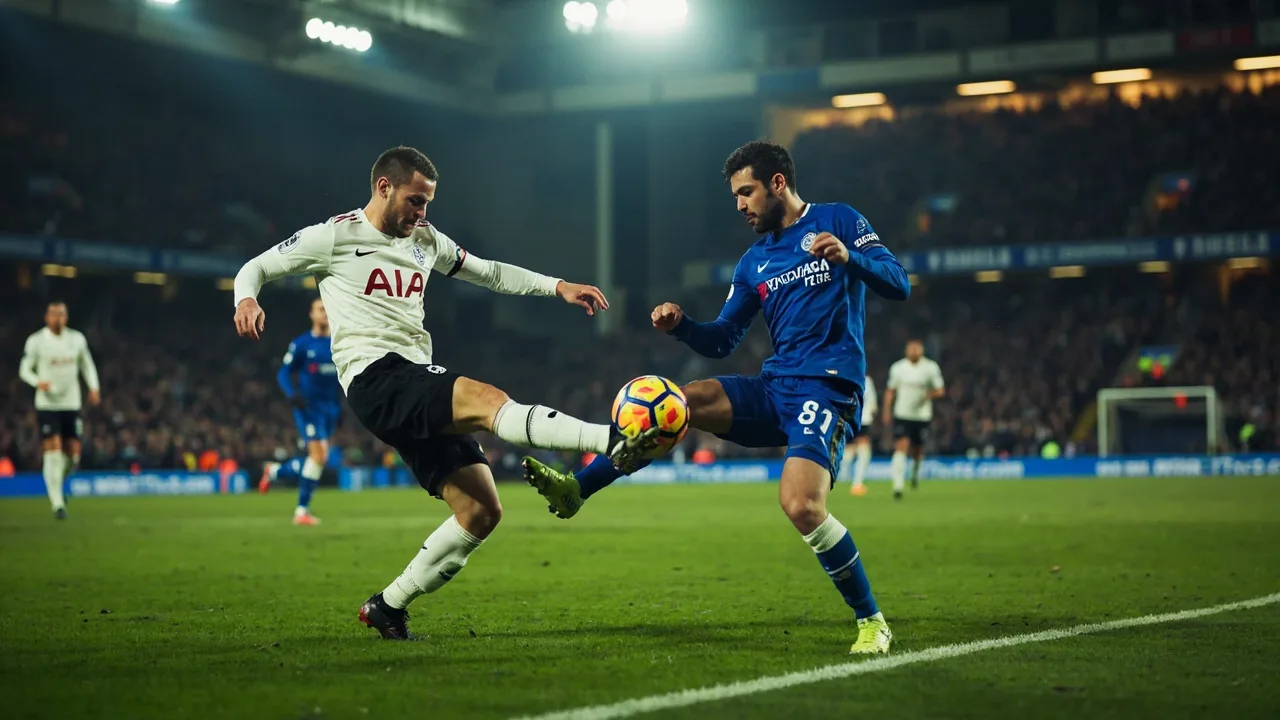
North London has become a test of pressing patience rather than raw speed
Spurs v Chelsea: the November pressing balance
Chelsea will probably make the first pass of the match look easy. Their centre backs may receive with space in front of them, their full backs may step towards the halfway line and their midfielders may expect Roberto De Zerbi's Tottenham to attack the first ball aggressively. That is the trap. Tottenham's best version of the new pressing approach is not a frantic scramble for every loose pass. It is a coordinated trap that forces Chelsea to play towards one side, then gives the second line a chance to arrive without leaving the central corridor exposed.

The first press is not the whole question
There is a danger in reducing Tottenham's recent work to a fashionable label. Pressing is not one action performed by the nearest player. It is a relationship between the first line, the midfield screen and the rest of the team. Roberto De Zerbi inherited a side that could recover possession but often struggled to keep it once the first collision had been won. The progress has been visible in the willingness of Tottenham's players to step forward together, but the next test is whether that collective movement survives a stronger opponent.
Chelsea have enough quality in midfield to move the ball around a compact press. Their wide players can attack the outside channel, their central midfielders can receive between the lines and their forwards can hold the ball long enough for a supporting runner to arrive. The relevant question is therefore not whether Tottenham can sprint at Chelsea's centre backs. It is whether their front player can obstruct the obvious passing lane without creating a new one.
The clearest way to understand this is through pressing research. Chris一个人的 detailed work on out-of-possession possession patterns, published by the Coaches Information Service, shows how ball recovery locations and the distance between defensive lines can influence whether a press succeeds. The practical lesson for Spurs is simple: shorten the distance to pressure the receiver, but do not drag the second line so far forward that the first line becomes isolated.
Tottenham should use a clear visual cue. One player may close the centre back, but the rest should curve towards the touchline rather than all chasing the ball in a straight line. That shape makes it harder for Chelsea to play through the first pressure and gives the central midfielder an opportunity to block the return pass. It also preserves a route for Tottenham to switch play if Chelsea escape on the opposite side.
The Premier League's tactical analysis of pressing and rest defence reinforces the value of that spacing. Premier League analysis repeatedly distinguishes between a team's action with the ball and the protection it provides when possession is lost. De Zerbi's Tottenham have shown that the press can be more aggressive. They now need to show that the moment after the press can be equally controlled.
Why Chelsea can punish an over eager Spurs press
Chelsea's best route through Tottenham's press will probably involve the goalkeeper. A short pass to a centre back can draw one midfielder out of position. If that midfielder jumps towards the ball, Chelsea can play into the half space behind the pressure. The danger is not a single pass. It is the second pass, played before Tottenham's midfield can recover its shape.
That is why Tottenham need their full backs to behave like coordinated midfielders rather than passive outlets. When the left sided press goes towards Chelsea's right, the left full back should move across the centre of the pitch to screen the central lane. The right full back can then remain available as the wide defender. This is not a rigid instruction to make every full back stand on the halfway line. It is about keeping the nearest central passing option covered.
The UEFA technical guidance on defensive organisation offers a useful principle: the team should protect the most dangerous central area before dealing with the less threatening flank. UEFA Technical Insights describes how defensive positioning can reduce the space available for a receiver and make the attacking team's progression more predictable. Spurs should apply that idea selectively, not copy it mechanically.
Against Chelsea, the strongest press may be the one that starts with a midfielder rather than a striker. A midfielder stepping towards the centre back can delay the progression and force Chelsea towards the touchline. A striker can then attack the first pass from the goalkeeper or screen the deeper midfielder. The roles become less about a dramatic individual duel and more about making one simple action create two passing options for Tottenham.
There is a cost to this approach. It requires discipline when the opponent has not yet made an error. Tottenham cannot press in the same way for ninety minutes and expect their structure to remain intact. The better performance may be a team that presses in phases: with real intensity when the ball is vulnerable, with a mid block when Chelsea have a safe pass, and with immediate pressure when the ball is turned over in a dangerous area.
Rest defence is the hidden route to a Chelsea point
Rest defence is often discussed as a back line problem, but it begins with the player who loses the ball. Tottenham's midfielders need to choose their first action with that in mind. A challenge from ten metres away may win possession, yet it can also leave a ten metre gap for Chelsea's first forward pass. A challenge from a slightly deeper position may be less spectacular and more valuable if it forces Chelsea sideways.
The work of Alex McLeish and the late Roberto De Zerbi's Brighton ideas make this particularly relevant. De Zerbi's Brighton were associated with ambitious out of possession structures, but the best examples were not endless sprints. They were moments when the team moved as a unit and left a safe passing lane to the keeper or a centre back. Spurs have adopted more of that ambition. The challenge now is to retain the underlying control.
Against Chelsea, the centre backs cannot be expected to read every press because they will also have to manage the striker and the arriving midfielder. The defensive midfielder's first job should be to make the central lane unattractive. The full backs need to protect the wide areas behind the press. The two central defenders can then defend the cross rather than chase a second ball into open space.
This is why a small forward adjustment can be more important than a dramatic change of formation. Tottenham could use a front player who is comfortable defending space rather than insisting on winning every aerial ball. The role does not mean avoiding duels. It means selecting duels that delay Chelsea's build up and bring the rest of the press closer.
The academic evidence summarised in the Journal of Sports Sciences review of football pressing supports the need for coordinated team behaviour. Individual effort can produce a regain in isolated cases, but repeatable success depends on spacing, timing and the quality of the support around the duel. Tottenham's pressing identity is now recognisable. The next stage is making it resistant to a team that can pass out of trouble.
The second ball is where the match may be won
Tottenham's recent improvement has been clearest when they have won the first challenge and organised the next action. Against Chelsea, however, the second ball will be contested in areas where both teams have numbers. A clearance can be a good outcome only if it changes the location of the next duel. If Spurs simply hoof the ball towards Chelsea's left full back and allow a fresh attack, the press has bought time rather than control.
That is the distinction between second ball recovery and second ball survival. Recovery means winning possession. Survival means ensuring that the team in possession cannot immediately progress. Tottenham should aim for the first, but must never ignore the second.
The FIFA Technical Study Group has repeatedly shown through its tactical reports that successful counter pressing depends on the timing and orientation of nearby players, not only on the player arriving first. Tottenham's midfield should therefore arrive on a curve. One player should collect the loose ball while another covers the forward passing lane behind him.
Chelsea will try to use their own second line after losing possession. Their forwards can attack the space behind Tottenham's full backs, and their central midfielders can arrive late to create a numerical advantage around the ball. Spurs need to avoid a situation in which the first line celebrates a regain while the rest of the team remains behind the ball. The reward for winning the duel should be a short pass into pressure, a safe pass away from danger or a controlled clearance.
Watch the body shape after the turnover. If Tottenham's nearest players immediately turn towards their own goal, they have recovered but not yet controlled. If they can orient towards Chelsea's goal while maintaining support behind the ball, the press has become a platform for possession rather than an interruption.
What I would change in the match plan
I would not begin by asking Tottenham's full backs to defend deeper for forty-five minutes. That would surrender the initiative and make Chelsea comfortable. I would instead give them a clear pressing trigger: when Chelsea's centre back receives with his back to goal, the nearest midfielder attacks the pass to the full back and the opposite full back moves across to protect the central lane.
Second, I would use one clearly defined rest defence signal. It might be the centre back stepping towards the ball. When that happens, the pivot should drop a few metres and the full back furthest from the ball should move inside. The aim is to make Chelsea's first forward pass difficult without pulling the entire team away from the box.
Third, Tottenham should avoid over committing to the first press. A five second pause with Chelsea's defenders is not weakness if it improves the next action. The press should be sharp when it is triggered, then dissolve into a compact mid block rather than continue as a series of disconnected lunges.
Finally, I would examine the first ten minutes after a Tottenham regain. If the team wins the ball and immediately plays back to its goalkeeper, the press has not necessarily failed. The important thing is whether the next pass attracts Chelsea forward and then releases the Tottenham player standing in the blind spot. That is the difference between chaos and a trap.
This is not a prediction of the result. Chelsea have the players to punish a crude press and Tottenham have the structure to make pressing look purposeful. The match will probably be decided by which side makes fewer meaningless forward movements and which side turns a loose ball into a controlled attacking opportunity. That is the modern Spurs question: can the new intensity survive a patient opponent? On current evidence, the answer is possible, but not yet proven.
A final judgement on the north London test
Tottenham's progress under Roberto De Zerbi should be judged by more than the number of wins. The side is becoming more willing to win the ball in defined areas. That is valuable, but it is only the first layer of a complete tactical identity.
Chelsea provide a useful examination because they can play through pressure. Spurs will need to leave one central area protected, use their full backs as coordinated defenders and make the second ball a continuation of the first action. If they do that, the press will not need to be frantic. It will need to be honest.
My view is that Tottenham have the stronger platform for a sustained contest. Their movement in the recent spell has shown a better understanding of when to leave the centre and when to close it. Chelsea, though, possess the cleaner short term passing options when a press breaks. The most likely match is therefore a tactical negotiation: Chelsea trying to pull Tottenham apart, Spurs trying to make the pitch feel narrow before the first ball is released.
The evidence from BBC Sport, UEFA, FIFA and the published football research points in the same direction. Pressing is a team structure, not a collection of individual reactions. Tottenham's next step is to turn that structure into a match plan that remains intact when the opponent refuses to panic.