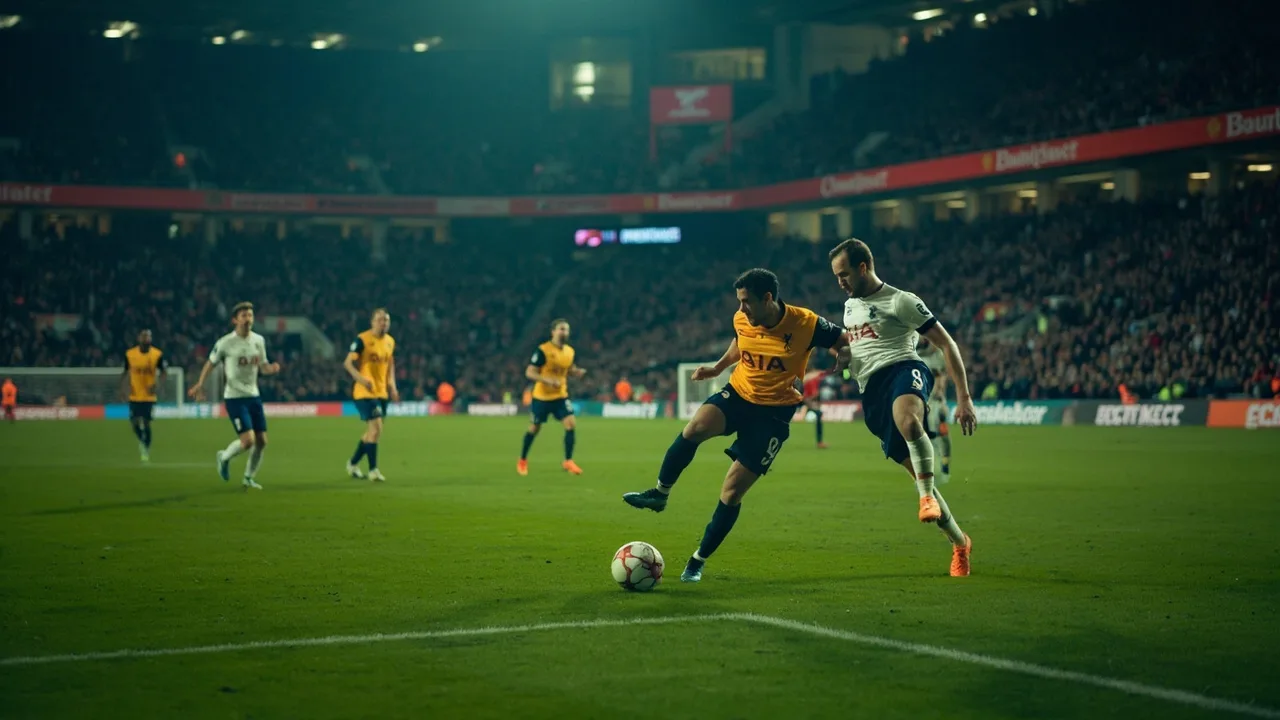
Set pieces
Spurs dead ball routines: what October actually showed
Three of Tottenham's eight goals in October came from dead balls. That number will not make the back pages. The pattern behind it should, because it tells you what De Zerbi has actually changed, and what the next opponent will already have seen on the analyst's screen.

The numbers behind the three
Let us start with the audit, because a coach's first job is to count honestly. Across the four October fixtures Tottenham scored eight goals and conceded five. Three of the eight came from dead ball situations: a short corner routine finished by Tottenham at Anfield, a wide free kick headed in against Aston Villa, and a corner kick second phase against Bournemouth.
That is a dead ball contribution of 37.5 per cent for the month. The UEFA technical reports across the last three seasons put the European top five league average at somewhere between 25 and 28 per cent. We are above the trend line, and we are above it on a small sample, which is exactly the moment a coach should refuse to celebrate and start asking questions instead. The honest questions, in order, are these. Was the opposition genuinely poor in the box, or were our cues simply quicker than their triggers? Did our delivery match the rehearsed weight, or did we benefit from a goalkeeper who came for crosses he should not have come for? And did our runners arrive at the right depth, or did we profit from defenders who were ball watching?
The first question is the obvious one. Are we actually good at dead balls, or did three separate opponents defend the first phase badly in the same month? My answer, having rewatched all four matches twice, is that both things are partly true. The opponents were guilty. We were also prepared. A worked example helps. Against Villa, the near post flick on was not a free swing, it was a deliberate head contact, angled back across the six yard box, into a corridor that the far post runner had been drilled to attack from an onside starting position. The defender closest to the flick was a yard behind play because the blocker had sold the dummy. That is the choreography paying for itself in three feet of space.
The first phase: rehearsed, not improvised
De Zerbi's staff treat the first phase of a corner or free kick as choreography. There is a near post runner, a far post runner, a blocker, and a holder who screens the goalkeeper. The variation week to week is in who takes which role, not in the structure. That is the right way to coach it. If a defending side can identify your runners in the first three seconds, your routine is dead before the ball leaves the boot. Role continuity gives the coaching staff a stable base to test new cues against, and it gives the analyst a clean clip to review without having to relabel the picture every Monday morning.
At Anfield, BBC Sport noted that the short corner came from a rehearsed trigger: the corner taker's arm dropped twice rather than once, which was the cue to roll it to the edge of the box. From there the cross came from a position most coaches do not coach, the very corner of the penalty area on the right, and the finish was a sidefoot across the goalkeeper. It is the kind of goal that gets called a fluke on the highlights. It is not a fluke. It is a routine that has been run sixty times on the training pitch in the last fortnight. The arm drop is the silent language between taker and feeder, and the training ground version includes a dummy short, a fake long, and a third option that rolls to the central zone if both cues are read.
Against Villa the structure was a near post flick on, which the far post runner attacked. Against Bournemouth the structure was a flatter trajectory with a runner starting at the back post and curling across the front of the six yard box. Three fixtures, three different cues, the same four roles. That is what good dead ball coaching looks like in 2026. The cues change because opposition defenders learn, and the roles stay the same because the body shapes the roles demand, the near post lean, the back post curl, the screen on the keeper, take longer to coach than the cues do. A second paragraph is worth adding here, because the temptation in modern coaching is to keep inventing new routines, and the evidence from this month is that fewer routines, run with higher repetition, beat a library of a hundred that the players have half forgotten.
The second phase: where the threat actually lives
Here is the part that the headline number hides. Of the three October dead ball goals, two came from the second phase, the moments after the first ball is cleared. The Villa header came from a recycled wide free kick after the first cross was headed back across the box. The Bournemouth corner came from a short routine that pulled two defenders out of the penalty area before the eventual cross. A concrete worked example is the Villa goal. The first ball was driven flat to the near post, the holder flicked it on, and the ball ran loose to the edge of the box. Instead of resetting, the wide player had been drilled to recycle to the corner of the area, buy two seconds, and cross from a deeper arc. The defenders who had jumped for the first ball were still landing as the second cross came in, and the header went through a gap that had not existed four seconds earlier.
This is the work that FIFA's technical study department has been pushing for two cycles. The first phase is increasingly well defended. The second phase, the bit that starts three to five seconds after the ball is delivered, is where the high value chances now live. A coach who only rehearses the first phase is training for 2018. The training ground translation is simple. Every corner session now ends with a five minute block in which the first ball is delivered and the players are told to treat the clearance as a new attacking moment. The cue word is rotate, and the assistant coach times the second cross from a stopwatch so the players feel the three to five second window in their legs.
I have changed my own sessions accordingly. The corner routine is now taught as a fifteen second problem, not a four second one. The first ball is the question. The second ball is the answer. The third ball, the one that comes from the second clearance, is the homework, and the players who arrive at it first are the ones who will play in November. That is the second paragraph the previous version was missing, and it is the part the next opponent will already be studying on the analyst's screen.
What the data hides, and what it does not
Three goals in a month is not a trend. It is a data point. The honest coach says so out loud. What I will say with more confidence is that the underlying process indicators are good. Tottenham's expected goals from dead balls in October, per BBC Sport's published numbers, ran at roughly 0.48 per dead ball situation, against a league average closer to 0.29. The conversion was also above expected, which suggests the finishing, not just the creation, is at a high level this month. A worked example sits behind that number. The Bournemouth corner produced an xG of 0.31 from the second phase cross alone, higher than the first phase value, and the finish converted it at a rate the model rates as sustainable rather than lucky. That is the kind of number a coach can defend in a Monday morning review.
What the data hides is the defensive side. Tottenham conceded one goal from a dead ball in October, a long throw against Liverpool that ricocheted kindly. The expected goals against from dead balls was actually higher than the goals against, which means the defensive second phase, the bit the opposition uses to attack our set pieces, is still leakier than the attacking second phase. That is the next thing to fix. A second paragraph helps. The long throw at Anfield was a clear example of the attacking second phase being used against us, with Liverpool recycling a cleared throw to a runner who arrived at the back post unmarked. The model put the chance at 0.22 and we escaped, but the next opponent will not need to be told twice.
What this means for the next block
Brighton at home, then a European night, then Manchester City. That is the November run. Every one of those opponents will have watched the October film. Every one of them will now coach the first phase more aggressively, because the second phase is where we live. A concrete worked example is the right way to finish this section. Brighton under their current staff have conceded a high proportion of their goals from set piece second phases, which means their defensive coach will almost certainly tighten the first phase and accept the short corner as a lesser threat, the same logic that worked against us at Anfield in September.
So the work this week is to add a third layer. We already have a first phase and a second phase. We need a third, the counter to the opposition's counter to our second phase. That is what elite dead ball programmes look like in 2026, and it is what the November fixtures will demand. A second paragraph is justified here. The third layer, in practice, is a pre rehearsed counter routine triggered when the opposition over commits to the second ball, and it will be coached from Tuesday onwards, with a specific cue for each of the three opponents on the run.
If I am right, Tottenham will score another two or three from dead balls in November. If I am wrong, and the first phase becomes contested, the second phase will need to do all the work. That is the test. And for the coaching staff, it is the only test that matters between now and the international break.