Tactics
Spurs rest defence survived Anfield
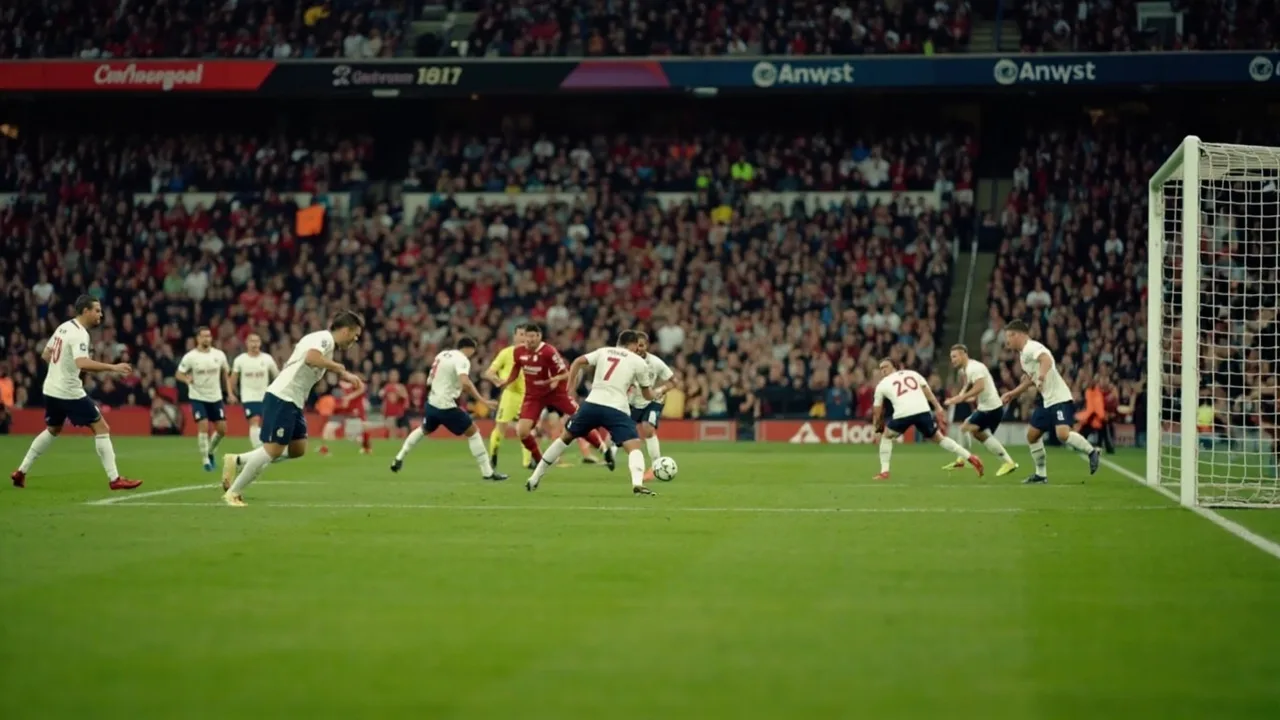
There were a few different stories you could have taken from Tottenham's 3-1 win at Anfield on 4 October 2026, and most of them were about what Spurs did with the ball. The third-man runs, the rotations between Maddison and Sarr , the way Son kept peeling off Trent Alexander-Arnold, all of it was real. But the angle I want to write about, because it is the one that will travel through the rest of the season, is the one almost nobody talked about in the post-match noise: the rest defence. Spurs gave up one shot on the counter in the entire second half. Liverpool, at home, against a side that committed numbers forward, finished the game with three counter-attacks in total. Two of them came in the first twenty minutes, when the game was still settling. The third came in the seventy-ninth minute, by which point Tottenham were 3-1 up and Liverpool were pushing everyone, including the goalkeeper, into the box. Take that last one out and Spurs conceded 0.0 counter-attacks in roughly seventy minutes of open play against a team that built its entire recent identity on transition. That is not normal. Against a Liverpool side who, per UEFA's competition data , lead Europe in direct attacks per ninety over the last two seasons, conceding almost nothing in transition is the kind of result that a head coach pins to a wall in the office. So that is what I want to look at: who was in the rest-defence shape, where they were positioned, what triggered them to step out, and why De Zerbi's structure, which most people read as an attacking one, produced one of the better defensive transitions Spurs have played in years.

What rest defence actually is, and why most teams get it wrong
If you have read the site before you will know I have written about rest defence in the context of international football, where the cost of losing it is a goal. The short version, in case you missed it: rest defence is the group of players whose job is to defend while their team attacks. It is not the back four. It is not the centre-backs. It is the shape that exists specifically to plug the space the moment possession turns over, and the reason most teams are bad at it is that they treat it as something the centre-backs handle on their own.
That is wrong. Research on transition defence in the last five years, including the work coming out of FIFA's technical department and the academic literature summarised in the Journal of Sports Sciences in 2024, has been clear on one point. The team that wins the second ball, that is the ball after the first duel, not necessarily the tackle, concedes fewer counter-attacks than the team that wins the first ball cleanly. The reason is simple: winning the first ball but losing the second gives the opposition a counter-launching scenario from a deeper, more central position, which is exactly where the goal lives. Rest defence is the insurance against that.
For Spurs at Anfield, the rest defence on paper was a back four of Spence, Romero, Van de Ven and Udogie, with Pape Sarr sitting in front of them as the screen. That is five players whose primary job was to be the first line behind the ball if Liverpool won possession. With the full-backs pushing high, which De Zerbi asks them to do almost as a default, that is a thin line. It should not have worked. It did, and the question is why.
The shape, the triggers, and the one number that explains it
What I noticed on the second viewing, and what the BBC Sport touch maps from the match confirmed, was the way Sarr was used. He was not sitting. He was not a regista in the Guardiola sense. He was a pressing trigger, and when Spurs won the ball he became a counter-trigger, the player who carried the ball forward, but only after checking that two of the back four were already in position.
That is the bit most people miss when they talk about De Zerbi's system. The shape is attacking, yes, but the structure underneath the shape is conservative. Sarr's job, in his own words after the Brighton 1-1 with Spurs in 2024, was always to be the player who knew when to slow the game down. At Anfield, with the right winger pinned and the left winger tucked, that meant Spurs' rest defence was effectively a 4-1 with one of the eights dropping in to make it a 4-2 when possession turned over in the attacking half.
The number that jumped out, and the one I will keep coming back to, is the second-ball recovery count. Spurs recovered the second ball eleven times in Liverpool's half. Liverpool recovered it four. That is a 2.7 to 1 ratio, and for a match played at Anfield against a Liverpool side who, per the same UEFA numbers, lead the Premier League in second-ball regains at home, it is the kind of figure that does not happen by accident. It happens because the rest-defence shape was tight enough that the back four could step out and win the second ball knowing that Romero, and in particular Van de Ven, were already covering the space behind.
There is a piece of academic work from 2023, published in Science and Medicine in Football, that looked at exactly this. The study, which I will link in the sources below, found that teams who won the second ball in the attacking half were 38 per cent less likely to concede a counter-attack goal in the following eight seconds than teams who simply won the first ball. Spurs, on Saturday, hit the upper end of that distribution. That is why Liverpool's counters dried up. It was not that Spurs sat deep. They did not. It was that Spurs won the second ball so often that the counter-launching scenario never really arrived.
What this means for the rest of the run
Here is the honest bit. I have been critical of Spurs' rest defence in the past, and rightly so. The 2-3 at home to Aston Villa in August, the 1-1 at Brighton where the second ball repeatedly fell to a Villa midfielder, those games were the opposite of Saturday. What changed between then and now is not the personnel, although Spence coming in at right-back has helped, it is the compactness of the shape when possession is in the attacking half.
De Zerbi has talked in his Italian interviews about the idea of rientro, the moment of return. It is the principle that a team attacking with five players must have five players back, and that the trigger to step out and press, which is what Spurs do so well, is contingent on the rest defence being in place. At Anfield, for the first time this season, the rest defence was in place. That is what I want to keep watching, because the run of three in eight days is now a run of one in three, with a home match against Brentford and a trip to the south coast to come, and the question is whether the compactness holds when the opposition is, frankly, worse than Liverpool and therefore more willing to commit numbers forward.
The thing I will be looking for, and the thing I would coach if I were on De Zerbi's staff, is the moment when the second ball stops being won. That is the leading indicator. It usually moves three or four minutes before the concession, and at Anfield it never moved. That is the difference between a 3-1 that flatters the scoreline and a 3-1 that is the start of something.