Set pieces
Spurs hire a set piece coach: what changes on the pitch
I have been waiting for this one. Tottenham Hotspur have confirmed the appointment of a dedicated set piece coach, and as an A Licence coach who spends more time on dead balls than is probably healthy, I want to talk about what the job is, what it is not, and what I will be watching from week one. Set pieces are roughly a third of all goals in the modern game, the research is now overwhelming, and yet most clubs still treat them as something the assistant manager fits in on a Friday morning. Spurs have decided, finally, that this is not good enough. So let me tell you what the new coach is actually going to be doing on Tuesday at Hotspur Way, because the training pitch is the only place this appointment will be judged.

The news, and why it matters more than the headline suggests
Tottenham Hotspur confirmed the appointment in early October 2026, and the club's official site framed it as a response to last season's numbers, which is the right way to frame it. According to BBC Sport's reporting on set piece trends, the share of Premier League goals from dead ball situations has climbed from roughly 27 per cent a decade ago to over 32 per cent in the last two completed seasons, and the trend has only gone one way. Spurs, for their part, were a middle of the league team from set pieces in 2025-26, not the worst, not the best, which is exactly the kind of profile that often triggers an investment of this kind. Middle is where the marginal gains live.
As coaches we know that the middle is also where owners and sporting directors get restless, because the easy fixes have been done and the next one per cent requires specialism. So the question is not whether the hire is a good idea, the research from the likes of UEFA's technical reports has been pointing this way for years, but what the new coach will actually be measured on. I will come to that in a moment, because I want to start with the role itself.
What a set piece coach actually owns
Let me be clear about something, because there is still confusion even at professional clubs. A set piece coach does not just design the corner routines. They own every dead ball in both directions, which is a much bigger list than supporters realise. Corners in, corners out, free kicks in attacking third, free kicks in defensive third, free kicks in the middle third that most teams ignore and should not, throw ins in the attacking third, throw ins in the defensive third, and goal kicks, which are now a set piece in everything but name. They also own the restarts after the ball goes out, the routines off a save, and the small details like which player takes the corner from which side depending on shape.
Add it all up and a top level set piece coach at a Premier League club is responsible for, conservatively, fifteen to twenty distinct routines, with three or four variations on each depending on the opposition and the game state. That is not a Friday job. That is a full week, with video on Monday, design on Tuesday and Wednesday, walkthroughs on Thursday, and delivery on the matchday minus one session. As FIFA's 2024 technical report on dead ball efficiency pointed out, the clubs who score most consistently from set pieces are the ones who treat them as a separate training block, not an add on to the tactical session.
Why Spurs waited this long is the real story
I have to be honest, I am slightly surprised it took this long. Arsenal hired a throw in specialist, which I wrote about on this site, and Brentford have had someone in the role for years under Thomas Frank, with the results obvious in the underlying numbers. Liverpool added a set piece coach in 2024 and their defensive record from corners improved in a single season. The Premier League as a whole has been professionalising the role since 2022, and BBC Sport's analysis of the trend documented nine of the twenty clubs having a dedicated coach by the start of 2025-26. Spurs were not among them, which is the bit that surprised me, given the club's stated ambition.
The honest answer, I think, is that Spurs have been changing head coaches and the person spec kept getting rewritten. Every new head coach arrived with their own ideas, and the role sat with the assistant or the first team coach as an extra. That is fine until you leak goals from a corner in the 88th minute against a mid table side, at which point the absence of a specialist starts to look like a structural decision rather than a workload choice. The appointment in October 2026 feels like the club admitting, finally, that this is a structural gap.
The week in the life of a Spurs set piece coach in October
Let me walk you through what I think the new coach's first full week looks like, because this is the part the supporters never see. Monday is video. The analyst will have clipped every set piece from the previous match, both for and against, and the coach will sit with the head coach and review. Not a long meeting, thirty to forty five minutes, but a focused one. The questions are simple. Did we hit the routine? Did the opposition change their marker system? What did our second contacts look like? Then the coach pulls the clips they want for the rest of the week and writes the session plan.
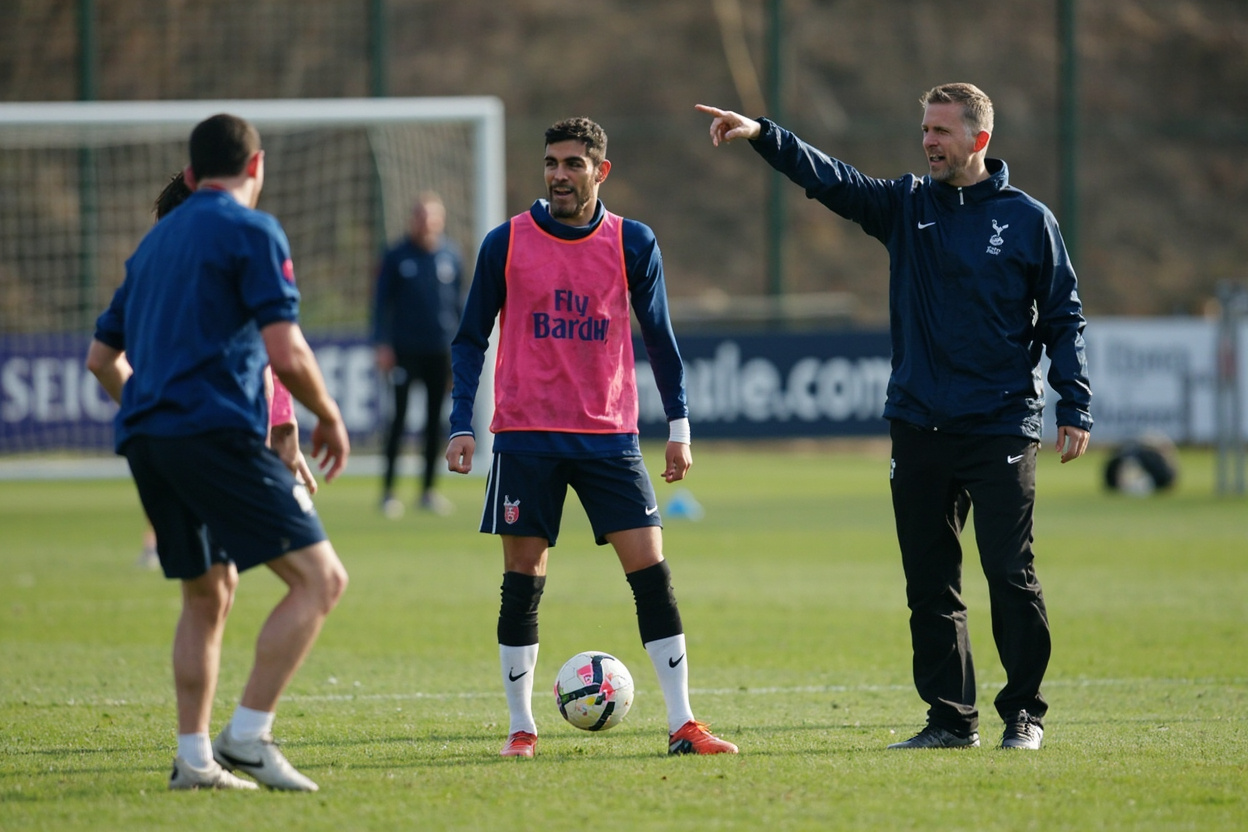
Tuesday and Wednesday are design days, but design in football terms does not mean drawing on a whiteboard. It means taking the squad out in small groups, the attacking unit for our corners, the defensive unit for theirs, and drilling specific movements against a live defence. Wednesday is when you test the variety, the short corner, the fake short, the block on the edge of the box, the runner from deep. Thursday is the most important session of the week, because Thursday is when the whole squad does set pieces together, with the first choice eleven against the likely starting defence, and the coaches watch the timing of runs and the relationships between players. By Friday the routines are walked through at low intensity, and by Saturday morning the coach is meeting the analyst again to finalise the matchday plan based on the opposition's tendencies. That is a full job. It is not a Friday add on.
What I will be measuring in the first three months
Now the bit that matters. How will I, as a viewer and a coach, judge whether this appointment is working? The first and most obvious metric is goals conceded from corners. Spurs have been a middle of the league team on this for two seasons, and the number I want to see move is the expected goals against from corners, not the raw goals, because goals are noisy. According to UEFA's training ground resources, the best set piece defences in Europe concede under 0.15 xG per match from corners. The worst concede over 0.40. I want to see Spurs in the top eight by Christmas, which is achievable.
The second metric is variety of corner routine. A good set piece coach, by the end of their first season, will have run between six and ten distinct corner routines, with at least three that are designed to look identical in the setup but produce different outcomes. If I am watching Spurs games in November and I can already tell from the way the players line up which routine is coming, the coach is not doing their job. The point of variety is not to score more, it is to deny the opposition the comfort of anticipating. The third metric is throw ins, because throw ins are the new set piece, and a team that wins them in the attacking third but loses them in the defensive third is giving away value at both ends.
The defensive side first, because Spurs have to stop bleeding
Let me talk about defending first, because that is where the points live. The most common defensive system in the Premier League is a hybrid of zonal and man marking, and I have written about this on coachsandy.site in the context of Denmark against Wales, where the system was tested in a high pressure match. Spurs have used a zonal system with a man marker on the opponent's biggest threat for several seasons, and the weaknesses have been consistent. The far post is the most common zone for conceded corners, the short corner is the most common outlet when the zonal block is set, and the second contact after a clearance is the most common goal type.
What I want to see from the new coach is simple. I want the far post assignments to be clear, I want the short corner trigger to be agreed in advance, and I want a designated second ball player. That is a minimum, and it is the kind of detail a specialist should fix in a fortnight. The reason most teams leak goals from corners is not that they cannot mark or cannot jump, it is that the assignments are unclear in the moment. The coach's job is to make the moment automatic. If I see a Spurs player at the far post unsure whether to mark the runner or the space, in November, the appointment is not working yet.
The attacking side, and the players who benefit
On the attacking side, the immediate beneficiaries are obvious. Spurs have a strong aerial profile, and a good set piece coach will get them onto the end of more of the corners the team already wins. The research from the FIFA technical department is consistent on this, the teams that score most from corners are not the ones with the tallest players, they are the ones with the best movement. Height helps, but timing and the second run help more.
I am particularly interested in how the coach uses the wide players. The modern corner is not just about the six yard box, it is about the players on the edge of the area, the ones whose job is to recycle the second ball. If a set piece coach can turn a few of those second contacts into shots from the edge of the box, the expected goals return is enormous, because the goalkeeper is moving, the defenders are ball watching, and a clean strike has a high chance of going in. This is the kind of detail the role unlocks, and it is the kind of detail a head coach with a full plate simply does not have time to design.
Where the new coach sits in the staff structure
This is a question I get from coaches all the time, and it is worth being specific. A set piece coach in a Premier League setup is not an assistant head coach. They are a specialist who reports into the head coach, usually with a dotted line to the first team coach or the assistant who runs the defensive side. They do not take training sessions on the pitch, except for their specific block. They do not do team meetings. They do not talk to the media. They sit, mostly, in the analysis room, on the grass for their own sessions, and in the dugout area on matchday, often just behind the bench with a laminated card showing the next three corner routines for either direction.
The reason I am being specific is that this is where appointments in this space can go wrong. If the new coach is treated as a generic member of the backroom staff, with set pieces as one item on a long list, the appointment will not work. If they are given the clear ownership of the area and the trust of the head coach, it will. The structure matters as much as the person. BBC Sport's reporting on the rise of set piece coaching has consistently flagged that the clubs where the role works best are the ones where the head coach publicly defers to the specialist on dead ball decisions.
The Spurs specific challenge, and why it is not just about set pieces
Here is the bit that I think the new coach will find tricky, and I want to say it out loud rather than wait. Spurs, over the last few seasons, have had a habit of conceding from set pieces in the moments when the team's shape is already under pressure. A corner conceded is rarely a one off event, it is usually the third or fourth action in a sequence, and the defending team is already on the back foot. A good set piece coach understands that the corner is not the only thing to fix, the build up to the corner is part of the same problem.
This is where the new coach has to work with the rest of the staff, particularly the defensive coach and the analyst, on what UEFA would call transition moments. If Spurs are giving the ball away cheaply, and the opposition is countering, and the counter ends in a corner, then the corner is not the issue, the turnover is. The set piece coach cannot fix the turnover, but they can work with the rest of the staff to make sure the defending team is set in time, and that the assignments are rehearsed for the specific context of arriving from a transition rather than from open play. The best set piece coaches in the world, and there are not many, are the ones who understand the game around the set piece as well.
What I would steal from other clubs in week one
If I were the new Spurs set piece coach, and I am not, here is what I would be looking at in my first week. First, I would study Brentford's defensive corner system in detail, because Thomas Frank's side have been the most consistent performers on this side of the ball for five years, and the system is well documented. The clever thing Brentford do is mix zones with a man marker on the opposition's best header, but the man marker is the player who is best at reading the flight, not the tallest, and that is a detail most clubs miss. Second, I would look at Liverpool's attacking corners under their set piece coach, because the variety is exceptional, and the way the runners are timed to arrive at different points is something I would want to borrow. Third, I would look at Arsenal's throw in work, because the appointment there has changed the way they attack from the touchline, and the data shows a clear uptick in chances created from throw ins in the final third.
None of this is a secret. It is all in the public domain through the work of analysts like those at FIFA and the case studies published by UEFA on their training ground portal. The point is that a new coach does not need to invent, they need to curate, and the first few weeks are about establishing which ideas the squad can execute and which need simplifying.
The risk, and the thing that worries me
The risk is the same as with any specialist appointment. The set piece coach arrives with energy, the head coach is enthusiastic, the first three or four games show an improvement, and then the season drifts, the routines get scouted, and the team starts conceding again. The research on the lifespan of set piece innovations is not great, because the public data is thin, but the pattern in football is familiar. A new idea works for six to nine months, then opposition analysts catch up, and the originator has to find the next idea. The set piece coach who lasts in the role is the one who has the supply of ideas to keep going, and the one who has the humility to change the routines even when they have scored the previous week.
My worry, specifically for Spurs, is that the head coach will rotate the role again in a year if the results do not arrive quickly, because the club has not been patient with specialists in the past. Set piece coaching is a long game, and the appointment needs to be defended through a poor run. If the club has not bought into that, the appointment will not last, and we will be writing this same piece in eighteen months about a new specialist. I hope I am wrong.
What this means for the rest of the league
The other thing worth saying is that this is not just a Spurs story. Every Premier League club now has to decide whether to invest in the role, and the answer for most, the data suggests, is yes. The clubs that have held out, and there are still a handful, are the ones I would be most interested in, because the marginal value of a set piece coach is highest at a team that has been leaking goals from corners. The clubs at the top of the league have already done this, and the clubs at the bottom have bigger structural problems, but the middle of the table, the clubs like Spurs, are the ones where the next one per cent is hiding in the dead balls.
I would expect, by the start of 2027-28, for every Premier League club to have someone in a role at least partly dedicated to set pieces, whether that is a full coach, a throw in specialist, or a goal kick coach, because the goal kick is the new front line. The work of the last few years, documented in BBC Sport's analysis and in the FIFA technical reports, has made it clear that this is not a fad. It is the next phase of professionalising the coaching staff, and Spurs have joined it, finally, in October 2026.
The bottom line for Spurs supporters
If you are a Tottenham supporter, here is the only thing you need to know. Your team has hired a set piece coach. The job is real, the work is detailed, and the results will be measured in the corners defended well, the variety of corner routines used, and the number of clean sheets that come from a set piece goal at the other end. The first few months will be about process, not outcomes, and the right response to a leaked corner in November is not panic, it is patience. The specialist has been given a job, the job is to make the dead ball moments automatic, and the rest is detail. I will be watching closely, as I always do, and I will be back on this site with a tactical breakdown of the first corner routine I see that looks like it has been designed by a professional rather than drawn on a napkin on Friday morning. That, more than any quote in any press conference, is the moment I will know the appointment is working.