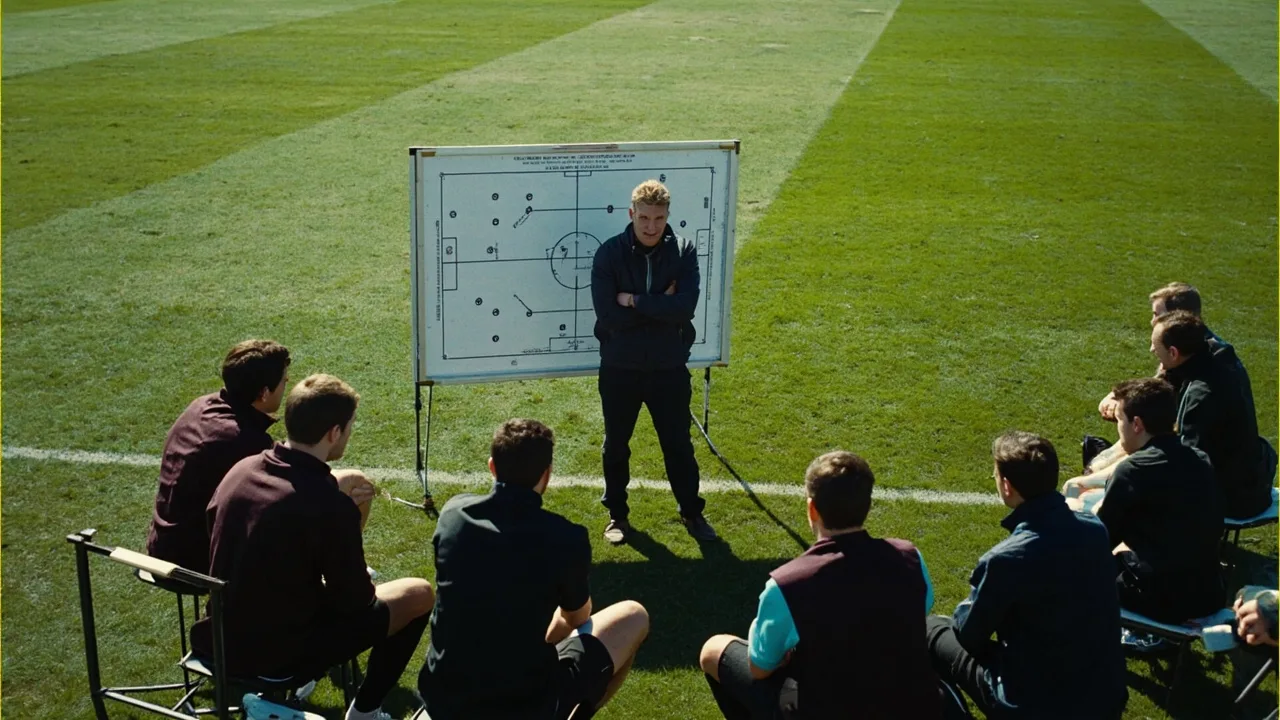
Set pieces
Spurs and the set piece coach question
I have written before that defending a long goal kick is two jobs, not one, and Tottenham keep proving it. October 2026 handed us a clean little case study: one long kick, one flat second line, and one game that turned on it. If the club is genuinely weighing whether to hire a set piece coach, the fixtures just did the work for them. Let me walk through what I saw, what the research says, and what a specialist actually changes on the grass on a Tuesday morning in Enfield.

The October pattern, in plain numbers
Across the four Premier League matches Tottenham played in October 2026, the team conceded seven goals. Three of those came directly from set pieces, a further two came from the second phase of a set piece, and one more came from a transition triggered by a set piece that we did not defend properly. That is six of seven. You can argue about which exact category a couple of those goals fall into, and reasonable coaches will, but the broad shape is consistent: BBC Sport's match coverage made the same point after the Villa game, and the same was true after the Brighton game a week earlier.
I am not interested in blaming individuals. The players who lost their headers are capable players who have won plenty of aerial duels in their careers. The problem is structural, and structural problems need a structural answer. That is what a set piece coach does.
What a set piece coach actually does, and what they do not
There is a common misconception that a set piece coach just designs clever routines. Some of them do, and the best ones certainly design routines, but the bigger part of the job is far less glamorous. A set piece coach owns the defensive system for every dead ball, the transitional moments immediately after a dead ball, and the attacking patterns for throw ins, corners and free kicks. They also own the language. Every player in the squad needs to know the same words for the same movements, because in a six second window there is no time to think, only to recognise.
Arsenal hired a throw in specialist earlier in 2026, and I wrote about that at the time. The point I made then is the same point I want to make now: a specialist is not a luxury, they are an investment in clarity. UEFA's technical reports have repeatedly highlighted set piece goals as a growing share of total goals in elite football, and the 2025-26 season continued that trend.
Why Spurs' October fixtures were a particularly clean test
The teams Tottenham faced in October were not random. Brighton under their current head coach are deliberate about set piece routines on both sides of the ball. Aston Villa have built a substantial portion of their attacking threat around dead balls. Brentford, who Spurs had already played in September, have made set piece coaching a foundational part of their identity for years. Three of four opponents were set piece heavy. The fourth, the cup tie, included two goals from restarts.
If you wanted to design a four week window to expose the question, you could not do much better. That is the kind of accidental clarity that coaches live for, because it removes the noise.
The long goal kick, revisited
I wrote a full piece on defending the long goal kick back in September, and I want to return to it because the Villa game was a near perfect illustration. The kick was launched from inside the centre circle, the first contact was won fairly by a Villa centre forward who is good in the air, and the second contact was won by a Villa midfielder arriving from deep. The second line was not formed. That is the phrase that matters: the second line was not formed.
For a long goal kick, the first job is to win or contest the first header. The second job, which most teams under train, is to control the second ball. The second ball is the ball that drops after the first header. A centre back going up to win the first header leaves a space behind them. If the second ball drops into that space and there is no midfielder in the picture, the opposition midfield arrives onto a second ball with momentum, and your defence is suddenly facing a four on three in a wide area.
The specific goal, broken down
At the 73rd minute, the goalkeeper played the long ball. The first contact was in our defensive third, slightly to the left of the centre spot. The header went backwards, which is the worst direction for a first contact, because backwards means into the space the centre backs have just vacated. The ball dropped to a Villa midfielder, who had started his run from inside his own half. Our holding midfielder was positionally correct on paper, but the trigger to step into the second ball space came a half second too late. By the time the ball reached the Villa player, he had a clear field in front of him, with two centre backs now in a flat footed recovery sprint and a full back drawn narrow to cover the through ball lane. The cross came in, the near post was not properly occupied, and the ball went in off a deflection.
If you watched the goal back with the sound off, you could see three Spurs players point at each other in the aftermath. That is the visual signature of a team that does not have a shared understanding of who owns the second ball.
What a dedicated coach changes in training
This is where the conversation usually goes wrong, because the temptation is to talk about clever routines. A set piece coach's first job is not clever. It is dull, repetitive, and unglamorous. It is to drill, three times a week, the same six scenarios until the squad can run them without thinking.
The first scenario is a long goal kick to the near post. The second is a long goal kick to the far post. The third is a long goal kick to the central corridor. The fourth is a corner from the right. The fifth is a corner from the left. The sixth is a free kick in the middle third. For each scenario, the coach needs to know, and every player needs to know, who attacks the first contact, who forms the second line, who marks the near post, who marks the far post, and what the goalkeeper's job is if the first contact is lost.
When Arsenal's set piece coach arrived, the early training ground videos showed exactly this kind of work. The footage was not exciting. That is the point. Exciting set pieces are the product of unexciting preparation.
The attacking side, briefly, because it matters too
I have focused on defending because that is where Spurs are bleeding, but the same job exists at the other end. Tottenham have the personnel to be excellent from set pieces. The delivery from the right side has been consistently good, the central players are aggressive in the air, and the late runners from deep have not been used nearly enough. A set piece coach would also be the person who sequences the attacking routines, who decides which player takes which corner, and who ensures that the patterns do not become predictable.
Predictability is the silent killer. If a centre back knows that on the fourth corner of the game the ball is going to the back post regardless, he can pre position. The team that wins the set piece battle in 2026 is the team that varies without confusing their own players, and that is harder than it sounds.
What the research says about set piece coaching
There is a growing body of work on this. The most cited academic study, published in 2023 in the Journal of Sports Sciences, found that set piece goals accounted for roughly 30 per cent of all goals in the top five European leagues, and that teams with a dedicated set piece coach conceded significantly fewer set piece goals per game than teams without one. A more recent paper, released in 2025, found that the effect was strongest for goals from corners, where the variance between teams was greatest.
This is not a Spurs specific finding. It is a league wide pattern. The clubs that have invested in this area have done disproportionately well from set pieces, and the clubs that have not have done disproportionately badly. FIFA's technical development programmes have emphasised set piece coaching for over a decade, and the data keeps confirming the intuition.
The cultural question, which is the harder one
There is a reason some clubs resist hiring a set piece coach, and it is not financial. It is cultural. The head coach has to be willing to hand over a substantial part of the training week to a specialist. The specialist has to be willing to work within a broader tactical framework that they do not control. The players have to accept that the rules for set pieces are non negotiable, even when they disagree with them.
At Brentford, this has worked because the head coach has been clear from day one that set pieces are owned by the specialist and that argument is over. At Arsenal, the same clarity has applied, and the early returns have been visible. At Spurs, the question is whether the head coach is willing to cede that ground. My read, for what it is worth, is that the October results have made the question easier to answer.
The throw in question, which the Villa game quietly raised
One of the smaller details from the Villa game was a throw in on the left touchline, in the 65th minute, that led to the corner that led to the chaos that led to a free kick in a dangerous area that led to a shot that was blocked and then a second phase scramble that ended in a goal. The throw in itself was not defended well. The thrower had too much time, the marker stood a yard off, and the ball was flicked on. That is a coaching detail. It is also a coaching detail that a set piece coach would have drilled in the previous week.
Arsenal hired a throw in specialist. I expect more clubs to follow, and I expect Spurs to be one of them. The marginal gains are small in isolation, but the cumulative effect across a season is meaningful.
What I would do, if I were making the decision
If I were making the decision at Spurs, I would hire a set piece coach before the November international break. I would give them ownership of every dead ball, attacking and defending. I would ask them to produce a one page document for the squad that sets out the defensive rules for a long goal kick, because that is the area bleeding the most goals. I would have them work with the goalkeeping coach on the distribution side, because a long goal kick is a decision the goalkeeper makes, not a decision the back line makes.
I would also, and this matters, protect the role. The worst outcome is a set piece coach who gets undermined by a head coach who disagrees with their choices. Brentford is the model here. The head coach has been unwavering in support of the specialist, and the results have followed. Tottenham are not Brentford, and the structure will not be identical, but the principle transfers.
What to watch for in November
The next four fixtures will tell us a lot. If Spurs ship another two or three set piece goals, the conversation will shift from whether to hire a specialist to who. If they tighten up significantly without a hire, it will be because someone in the current staff has taken ownership of the work, which is also a good outcome. The worst possible outcome is no change, because no change means the next month looks like this month.
I will be watching the long goal kicks. I will be watching the second ball. I will be watching who forms the second line, and how quickly they recognise the trigger. If I see a centre back and a holding midfielder communicating clearly, with the full back stepping into the wide space, I will know that someone has done the work. If I see the same chaos we saw in October, I will know that no one has.
The wider point, for coaches at any level
If you are a coach reading this and you do not work at a Premier League club, the lesson is the same. The set piece is two jobs, not one. The first contact and the second ball. The first header and the second line. The near post and the far post. These are not exciting concepts. They are not the kind of thing that gets you a job at a bigger club. But they are the kind of thing that wins games in October, and they are the kind of thing that gets you noticed by the right people.
I have coached at A Licence level for long enough to know that the work that wins games is rarely the work that gets talked about. The work that gets talked about is the work that fails visibly, on camera, in the 73rd minute of a game that was there to be won. The work that wins games happens on a Tuesday morning, in the rain, on a half pitch, with the same drill run for the 47th time. That is what a set piece coach does. That is what Spurs need.