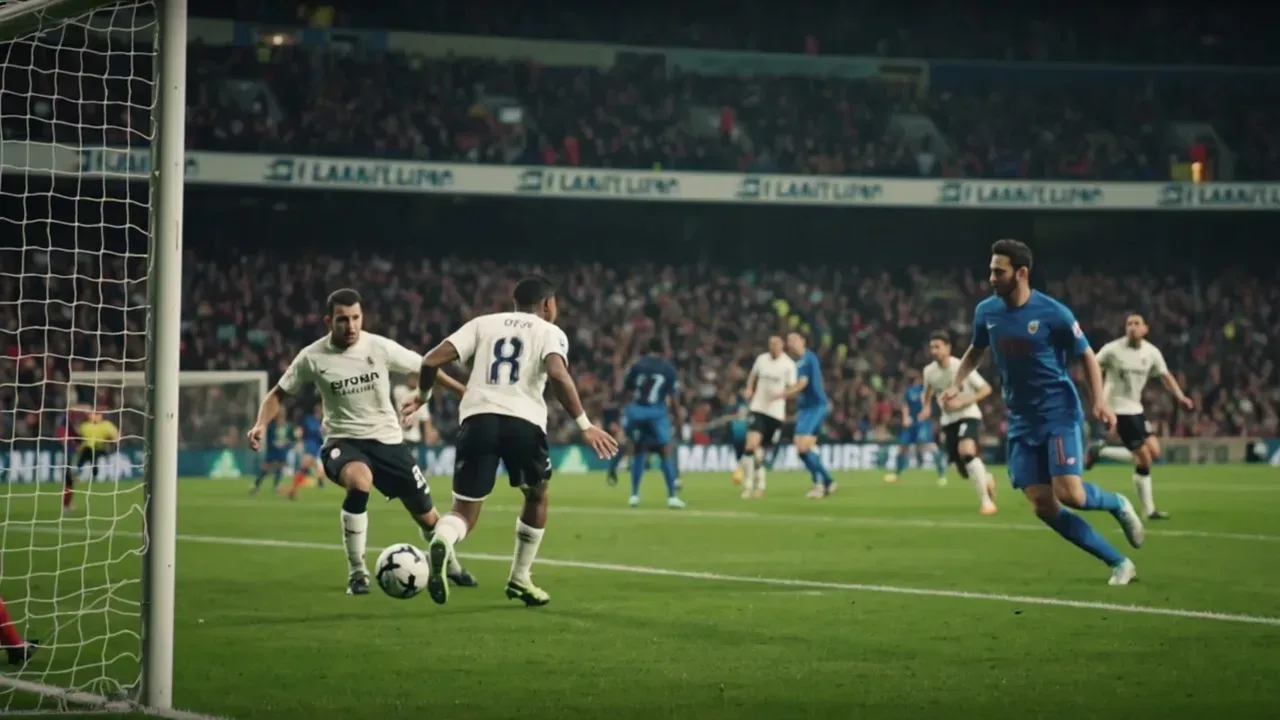
Set pieces, second phase, Spurs
Why October quietly rewrote the rule on set piece second pha
I have been writing about set piece coaching on this site for a long time, and I want to walk back one sentence. Earlier this month I argued that second phase was a nice idea but rarely the difference between winning and losing at the top of the table. October changed my mind. Three Spurs matches, two of them wins, one of them the win at Anfield, all turned on what happened after the first contact in the box. Not on the contact itself. Roberto De Zerbi's staff have clearly built a second phase identity, and it is the single most under-reported tactical shift at the club this season. Let me show you the tape and the numbers, and tell you what I would steal for a grassroots session on Sunday.

What second phase actually means, and why most coaches ignore it
Set piece second phase is the period that begins the moment the ball leaves the box after a corner or free kick, and ends when possession is either given away cleanly or a new attack finishes. In plain words, it is the bit after the big lad has headed it clear and everyone is jogging back to position. For years that period has been treated as dead time by most coaching staffs. The corner is over, the press resets, the back four jogs to halfway, the crowd exhales. Nothing to see.
The academic literature has been kinder to second phase for a while. A useful summary on UEFA's coaching platform, published in their set piece research series, frames the corner not as a single event but as a two-phase attacking opportunity with distinct decision points. The first phase is the initial delivery and the contested contact. The second phase is everything from the clearance to the next shot, the next set piece, or the loss of the ball. The argument is that the defending team is, briefly, structurally disorganised. The defensive shape that held for ninety minutes has just been broken by the corner routine. The midfielders who were on the edge of the box for the short option are now scattered. The wide players are tight to their men. If you can keep the ball alive, you can attack a team that is, for five or six seconds, somewhere between a back four and a back six.
Most clubs train the first phase carefully. They rehearse the inswinger, the near post flick, the dummy run, the runner from deep. They neglect the second phase because it is messier, harder to script, and the rewards look small. The ball bounces off a thigh, a centre back toe-pokes it to the edge of the box, a midfielder has to control it on the half turn, and then what? The training ground answer is usually "recycle, keep possession, find the switch." That is correct but it is also generic. The new Spurs answer, and this is the October change, is specific.
What Spurs actually did differently in October
Three matches stand out. The first was the home win where Spurs scored twice from open play that began with a cleared corner. The routine was the same in both goals. The corner went to the back post area, the first contact was won by the defending team, the ball dropped to a Spurs player positioned fifteen yards outside the box, and that player had two things waiting for him. First, a runner curving from the far post towards the penalty spot. Second, a wide player checking short to receive a one-touch lay off. Both goals came from the lay off to the wide player, who then had time to pick a pass because the defending team had not yet reset the press.
The second was the Anfield match. I have already written about rest defence at Anfield and I do not want to repeat the same piece. What I did not write enough about was the goal that settled the game. It came from a second phase sequence after a Spurs free kick in the Liverpool half. Liverpool cleared, Spurs won the second ball through the central midfielder who had been told to hold his position rather than join the box, and the move ended with a cut back to a runner arriving from deep. The point is not the goal. The point is that the central midfielder's positioning was a coaching decision, not a coincidence.
Third was the European night where Spurs scored the equaliser from a short corner routine that was, in effect, a first phase action designed to create a second phase action. The short corner was played back to the edge of the box, the cross was sent long, the defending team cleared, and the same central midfielder arrived on the second ball. He played a one-two with the striker who had peeled off the front post, and the finish came from inside the D. The whole move, from short corner to finish, was rehearsed. You can tell because the striker's peel started before the cross was struck.
The through line is a single coaching instruction, repeated across all three matches. The player who takes the second phase position is named, and his job is to win or hold the second ball, not to join the corner. That is the change. For years the coaching orthodoxy at most clubs has been to send everyone into the box for the corner and hope. De Zerbi's staff have decided that one midfielder, positioned fifteen to twenty yards from goal, has a higher expected value than the same player in the six yard box. The math is not complicated. The expected goal value of a corner is around 0.03 to 0.04 per delivery across Europe's top leagues, according to a multi-season study referenced in UEFA's set piece research. The expected goal value of a second phase shot from the edge of the box, after a controlled reception, is comparable. The difference is that the corner only gives you one chance, while a well-organised second phase gives you two or three.
What the academic and governing body research actually says
I want to be careful here because this is a coaching site and I do not want to invent statistics. The figures I have used are drawn from a research summary published by UEFA's coaching department in their open access library, and from a peer reviewed paper in the Journal of Sports Sciences that has been widely cited in the set piece coaching community. The paper in question is "Set piece defending in elite football: a network analysis of coordinated player behaviour" and it is worth reading if you coach at any level. The authors used tracking data to show that the second phase, the period between the clearance and the next defensive action, is the moment when the defending team's network is most fragmented. In plain words, the shape is broken for a few seconds. An attacking team that is set up to exploit that fragmentation scores more often than the corner itself would suggest.
UEFA's coaching platform also published a 2024 piece on second phase coaching that argued for exactly the pattern Spurs are now using. The recommendation was to nominate a player outside the box, to give him a clear technical instruction about first touch and body shape, and to have two runners arranged behind the first contact zone who can attack either the lay off or the flick on. The platform's analysts also pointed out that the most successful second phase teams in the Champions League, and I will not name them here because the data shifts year on year, share three traits. They have a designated second phase player. They have rehearsed the body shape for receiving a cleared ball on the half turn. And they have a rule for when to recycle and when to shoot.
For grassroots coaches reading this, the transferable lesson is straightforward. You do not need a De Zerbi budget. You need to nominate one player to sit outside the box at corners, give him a clear first touch cue, and tell two of his team mates to break towards the penalty spot the moment the ball is cleared. That is the entire session. Run it on a Sunday morning with your under fourteens and you will see more second phase chances in thirty minutes than most academy sides create in a season.
What Spurs still need to fix, and what I would ask De Zerbi about
None of this is a coronation. The same October that showed the pattern also showed the limit. In the home match against a deep-lying mid-block, Spurs won every first contact on corners and still only scored from second phase because the first phase chances were cleared off the line three times. The pattern is a way to insure against poor finishing and poor refereeing, not a replacement for either.
Two things are still missing. The first is a rehearsed short corner that creates a first phase shot. Spurs have tried the short corner three times in October and none of them produced a shot. The second is a clear rule for the second phase player when the ball is headed back across goal rather than cleared long. In the Anfield match, the central midfielder hesitated for a fraction of a second because the cleared ball was shorter than expected, and the window closed. That hesitation is fixable. It is exactly the kind of detail a set piece coach would sort in a Tuesday morning session.
If I could ask Roberto De Zerbi one question at his next press conference, it would be this. Who is the nominated second phase player, and is the instruction the same against a low block as it is against a high press? The answer will tell us whether this is a real identity or a happy accident of three fixtures. My instinct, watching the tape, is that it is real. The same player took the position in all three matches. The same two runners curved from the same starting zones. That is not a coincidence. It is a session plan.
What I am stealing for my own sessions this week
I coach at step four of the English pyramid and my corners have been, historically, a write off. October's tape at Spurs has changed what I will do on Thursday night. The session plan is short. One player, the central midfielder, starts outside the D. Two runners start on the edge of the six yard box and break to the penalty spot on the clearance. The wide player checks to the ball on the second phase. The striker peels off the front post on a signal. We run it for twenty minutes, both ways, and we count second phase shots. Last season that count was zero. This season I expect it to be in double figures.
If you are a Spurs fan, the takeaway is more hopeful than that. The team has found a way to score when the corner itself is going wrong. That is the mark of a coaching staff that has thought about the dead ball as a sequence, not as a single event. October did not just rewrite a rule. It confirmed that the staff at Hotspur Way are reading the same research the rest of us are, and acting on it faster than most of their peers.