Tactical culture
Spurs Fan Voice: The Change Under De Zerbi
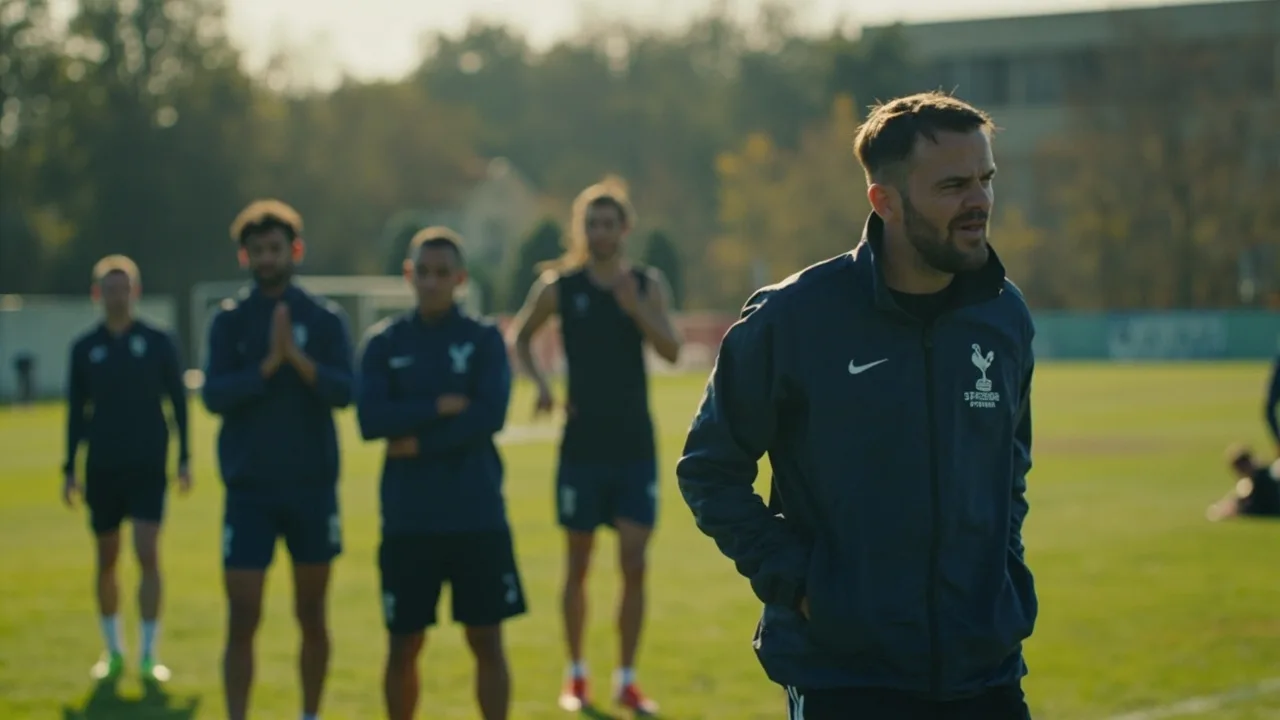
When a head coach arrives with a clear tactical idea, the first photographs can be misleading. They show the manager pointing, the players listening and the training reports full of words. The real change becomes visible when the same team encounters an unfamiliar game state and responds without needing to look repeatedly towards the touchline. Tottenham's season under Roberto De Zerbi is beginning to offer evidence of that kind, although the October and early November results should not be confused with a completed revolution.

The visible change is not merely a new shape
Tottenham's tactical identity under Roberto De Zerbi has been associated with a more ambitious approach to possession, sharper support around the ball and a willingness to play through pressure rather than retreat whenever a pass becomes difficult. Those are useful labels, but they do not explain the change on their own. A formation drawn on a whiteboard is only an intention until it survives the awkward second ball, the misplaced full back and the opponent who deliberately sends the ball into the channel behind the first pass.
The relevant question now is whether Spurs' players can recognise the same tactical situation in different forms. When their first attacking option is closed, do they create another? When possession is lost, do they protect the central lane and force the opponent towards a less dangerous area? When a game becomes fragmented, can they rebuild their spacing without waiting for instructions from the bench?
There is an important distinction between control and permission. De Zerbi's Tottenham side has increasingly shown signs of players making decisions that fit the wider plan. That is different from a group simply being allowed to improvise. The distinction can be explored through De Zerbi's background at Brighton, where the search for technical players did not remove the need for collective rules. The wider principles remain consistent with the work of researchers such as Jonathan Pass, whose observations on intense pressing and coordinated possession show why successful teams need repeatable cues rather than endless individual freedom. BBC Sport regularly separates what a team attempts from what it actually executes, and that is the right standard here too.
The encouraging evidence is that Tottenham have not looked like a side whose entire identity depends on one fixed shape. Their attacking and defensive organisation has varied with the opponent, while retaining recognisable ideas: attacking support behind the ball, purposeful rest defence and attempts to recover the second ball before the opponent can turn towards goal.
Yet the distinction matters because a promising pattern is not the same as a completed transformation. The useful evidence will be whether these behaviours remain when the fixture list becomes less favourable and when individual matches produce less comfortable conclusions.
The strongest signal may be shared accountability
Football audiences often describe a manager's impact through visible commands: a new pressing shape, a different full back pairing, a particular type of midfielder or a willingness to select a younger player. Those are legitimate measures. The less visible change at Spurs may be the distribution of responsibility between the manager, the players and the supporters.
This can sound like a soft topic, but it has a direct tactical consequence. A player who understands not only what to do but why the team is doing it can make faster decisions. A supporter who recognises a deliberate tactical trade off is less likely to treat every sideways pass or temporary loss of possession as a crisis. A coach who can explain the plan in public creates a common language for all three groups.
The most striking evidence, then, may not be a single match. It may be the absence of the same recurring complaints that accompanied earlier stages of De Zerbi's Tottenham project. The conversation around the team has increasingly centred on what the players are trying to achieve, not simply whether every action meets a traditional expectation of what Tottenham should be.
That is a cultural shift, not a licence for a free-for-all. De Zerbi's task is to keep a demanding structure while giving players room to interpret it. The players' task is to accept responsibility for collective actions rather than waiting to be told which detail has gone wrong. Supporters' responsibility is to distinguish an execution error from a principle the manager is consciously testing.
UEFA's coaching and performance resources repeatedly stress the value of clear roles, communication and repeatable team concepts. UEFA provides useful context for elite coaching, but the point applies at every level: players cannot contribute intelligently to a game plan if they do not understand its purpose.
My view is that this is the most meaningful sign of progress at Tottenham, but it should be judged carefully. Shared accountability only works when accountability remains specific. It cannot mean that every mistake is accepted in the name of freedom. It means that players are expected to make decisions, make corrections and understand the consequence when those decisions are poor.
What October and November actually tell us
The recent run has provided a useful sample, but not a final verdict. Tottenham's October schedule demanded different things from the team. There were matches in which they needed to control the game, others in which a transition favoured the opponent, and fixtures that required managing energy across a congested period. The strongest tactical conclusions come from comparing those contexts rather than selecting the most attractive clips.
Against Liverpool at Anfield, Tottenham's rest defence was tested by an opponent capable of finding space quickly. Their response showed that De Zerbi's structure is not simply about possession for its own sake. The team must still account for the space behind and beside the ball when attacking numbers are committed. This is consistent with the rest defence evidence discussed by the BBC Sport match analysis and with UEFA's broader examination of team shape in high-intensity contests.
Other matches have shown the value of a more deliberate attacking approach. The central midfielders have often received the ball between lines or after the team has worked around the first pressure. The wider attackers have had clearer relationships with the full backs, while the team has looked less dependent on one individual burst carrying the entire attacking burden.
There has also been progress in the defensive phase. Tottenham have shown greater willingness to step towards the ball and cut passing options, but the next test is whether that pressing remains coherent when the first wave fails to win the ball. A press is only useful when the team has prepared the second ball, protected the space behind the presser and understood which opponent should be forced towards the touchline.
The research on pressing by德斯? is best used as a framework, not as proof of a matchday pattern. In football, coordinated pressure must produce either a turnover or a predictable attacking direction. Without either, the team has merely run towards the ball. That is why the analytical language used by FIFA and elite coaching staffs is important: spacing, body orientation and recovery positions are observable features of performance.
There is a caution here. A short sequence of encouraging matches can make an unfinished project look complete. De Zerbi inherited a squad with different experience levels, and adaptation is unlikely to be linear. Some weeks will reveal progress; others will expose tension between the new principles and established habits.
The tactical questions supporters should ask
The answer should not be that every supporter must become a coach. It is that supporters can ask better questions when the tactical purpose is clear. Instead of asking whether a player passed sideways, ask whether that pass moved the opponent towards a particular side and whether Spurs had enough bodies around the ball to attack the next space.
Instead of asking why a full back advanced, ask whether the centre backs retained their rest defence relationship and whether the goalkeeper had a safe passing option if possession broke down. Instead of asking why the team pressed high, ask whether the pressing trap was designed to force a particular pass and whether the second ball was covered.
This kind of questioning also helps supporters identify when a tactical idea is failing. A deliberate risk is not the same as an accidental mistake. If Tottenham's pressing plan is designed to recover possession in a specific zone, a successful opponent escape does not invalidate it immediately. Repeated escapes in the same zone, particularly when they lead to dangerous chances, do.
That approach gives the coaching process a fairer test. It does not remove criticism. It makes criticism more precise. De Zerbi should still be judged by results, defensive stability and the quality of his decisions, but supporters should not confuse a developing model with a lack of identity.
There is also a responsibility for the manager. If players are expected to share accountability, they must be told which decisions belong to them and which boundaries remain fixed. The best modern coaching cultures do not treat autonomy as the absence of standards. They make standards explicit so that players can exercise judgement inside them.
A project becoming clearer, not yet complete
Tottenham under Roberto De Zerbi appear to be developing a clearer balance between ambition and control. The team is not simply trying to dominate every phase. It is trying to create attacking possibilities while retaining the shape needed to defend the first transition. The more convincing sign is that this balance is becoming easier for players to recognise.
That should be encouraging for the club's direction. The next step is consistency. The team must make the same tactical decisions when the match is comfortable, when it is balanced and when it is under pressure. It must show that the new relationships work without the ball, that the pressing has a defined second phase and that the supporters understand what progress looks like.
For now, I would call this a promising tactical culture in development, not a finished article. The visible football has improved in important ways. The less visible evidence, a common language between players, manager and supporters, may prove just as valuable.
The conclusion is not that De Zerbi has solved every question. It is that Spurs have moved closer to a team in which control is shared through understanding rather than imposed through constant instruction. That is a genuinely new era for the club, provided the standard remains high and every participant accepts the responsibility attached to the idea.